This coming Monday is Memorial Day in the United States, a day when we honor those who lost their lives while serving in the U.S. military. The tradition stretches back to the post–Civil War era. While 1868 marked the first widely celebrated Memorial Day, smaller local commemorations took place as early as 1864.
Displaying the American flag at homes, businesses, commemorative events, and veterans’ graves is one way we solemnly honor those who died in military service. But unlike Flag Day, Veterans Day, and the Fourth of July, when typical flag etiquette applies, Memorial Day comes with a few special considerations to keep in mind. Here’s what you need to know.
The Memorial Day Flag Rule: Fly It Half-Staff from Sunrise to Noon, Then Full Staff Until Sunset

Memorial Day protocol dictates that the American flag must be flown at half-staff for a specific length of time. According to the U.S. Department of Veterans Affairs, “On Memorial Day the flag should be flown at half-staff from sunrise until noon only, then raised briskly to the top of the staff until sunset, in honor of the nation’s battle heroes.”
According to tradition, displaying the flag at half-staff on Memorial Day from sunrise to noon honors U.S. military personnel who have died on active duty, while flying it fully raised honors living veterans. It also symbolizes how America endures in the face of loss.
This practice goes back as far as 1906, when it appeared in Army manuals, according to Live Science, and was later codified by Congress.
Half-staff is defined by the United States Flag Code as one-half the distance between the top and bottom of the staff. More specifically, the Emily Post Institute notes that when raising your flag to the half-staff position, you should first hoist it to the peak for a moment before lowering it to half-staff. Always unfurl or unfold your flag briskly, lower it slowly and solemnly, and display it with the blue union up.
If you are flying the flag from a shorter pole projecting horizontally or at an angle from a building, the union of the flag should be placed at the staff’s peak, unless it’s at half-staff.
Those are the basics, but there are exceptions:
When to Use a Black Mourning Streamer
If you don’t have sufficient space on the pole to fly it at half-staff, you may display your flag with a black mourning streamer (pictured at the top of this post). Attach it just below the finial.
How to Display the Flag on Walls or Windows

Flags may also be displayed on indoor or outdoor walls or in windows. In this case, hang it flat, horizontally or vertically, with the union in the uppermost corner, to the flag’s own right, which is the observer’s left.


Illuminating the Flag at Night
If you want to display the flag past sunset, there’s a right way to do it. The U.S. Flag Code states, “when a patriotic effect is desired, the flag may be displayed twenty-four hours a day if properly illuminated during the hours of darkness.”
A spotlight should do the trick nicely. But keep in mind that according to protocol, your flag shouldn’t be displayed in rain, snow, or gusty wind unless it’s made from an all-weather material that can withstand the elements.
But Always Remember…
Never allow your flag to touch the ground or use any flag that is tattered, torn, or dirty. Flags may be washed or dry-cleaned and repaired, but if your Red, White, and Blue is beyond saving, many American Legion posts offer disposal ceremonies for unserviceable flags.
How to Place Flags on Veterans’ Graves on Memorial Day

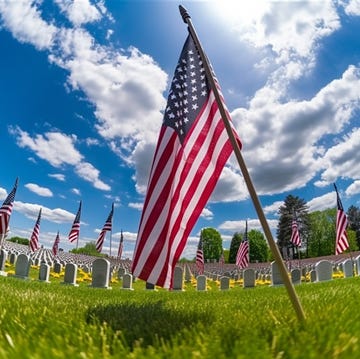
There’s another important tradition around the Stars and Stripes on Memorial Day, and that’s displaying small flags on the graves of veterans.
Every year, volunteers across the country, organized by groups such as the Military Veteran Project, take to our nation’s cemeteries and place flags in front of the graves of our fallen service members. (All veterans’ graves are eligible to receive the flags, but not all do because there aren’t enough volunteers to place them.)
While some military cemeteries have small flag holders already installed, flags should otherwise be placed in the center of the grave, a foot in front of the headstone. They are typically removed shortly after the holiday.
The Etiquette of Flag-Themed Clothing
Wearing T-shirts and other attire emblazoned with the Red, White, and Blue is also popular on Memorial Day, but should you? Opinions on this matter certainly vary, but The American Legion takes a clear stance: “Unless an article of clothing is made from an actual United States flag, there is NO breach of flag etiquette whatsoever.” There’s no official rule or law governing this kind of fashion choice.
What to Know If You Participate in a Memorial Day Parade

In a Memorial Day parade, it’s never proper to drape a flag over a float. It should instead be hung from a staff or suspended so that it falls freely.
If you’re carrying the flag while marching in a procession with other flags, the Stars and Stripes takes a place of honor. There are two appropriate options: (1) It should appear on what’s called the “marching right,” or the farthest right position in line (again, that’s the flag’s own right, not the observer’s). (2) Alternatively, it should appear at the front and center of the flag line.
Terri Robertson has been an editor and storyteller for more than 20 years. As Deputy Digital Editor at Country Living, she curates daily newsletters and has found a niche writing about odd corners of the internet and people embracing American life off the beaten path. She’s passionate about gardening and nature, writing about everything from super monarchs to supermoons. She also contributes to Country Living’s entertainment coverage, including HGTV stars, popular TV shows, and music. Terri began her career proofreading Southern Living cookbooks—a first job befitting an English major with a childhood penchant for reading her mom’s cookbooks—and went on to edit many food, garden, and lifestyle titles. She later worked for the University of Alabama’s marketing and communications division, capturing the stories of students and faculty. Returning to lifestyle media in 2017, she covered local arts, culture, and business news in Birmingham, Alabama, for Bham Now and later served as digital media manager for Flower magazine, a luxury home, garden, and lifestyle publication, before finding her home at Country Living. She and her husband live with their four cats in Birmingham.
Jill Gleeson is a travel journalist and memoirist based in the Appalachian Mountains of western Pennsylvania who has written for websites and publications including Good Housekeeping, Woman’s Day, Country Living, Washingtonian, Gothamist, Canadian Traveller, and EDGE Media Network. Jill is the travel editor for Enchanted Living. Learn more about her journey at gleesonreboots.com.